FIELD FILE · BLACK-SHUCKDOGMAN & CANINEREGIONAL LEGEND
Black Shuck
Also known as Old Shuck, Shuck the Dog-fiend, The Black Dog of Bungay
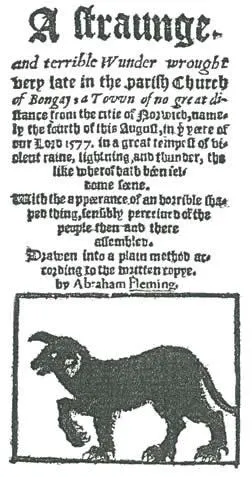
East Anglia’s ghostly black hound, blamed for the deadly church storm of August 1577 in Bungay and Blythburgh and still said to roam the coast.
Black Shuck is the best-known of England’s many phantom black dogs: a huge, shaggy hound said to pad silently along the lanes, cliffs and marshes of Norfolk and Suffolk. The name is usually traced to the Old English scucca, meaning “devil” or “fiend”, and the creature first appears in print under that name in 1850, when the antiquarian E. S. Taylor described “Shuck the Dog-fiend” in Notes and Queries. Long before then, though, coastal villagers told of a dark dog whose appearance could mean a death in the family.
The legend’s defining moment came on 4 August 1577, a Sunday, when a violent thunderstorm struck two Suffolk churches during morning service. In a pamphlet rushed out that year, A Straunge and Terrible Wunder, the London writer Abraham Fleming claimed that a black dog “or the divel in such a likenesse” had run through St Mary’s Church in Bungay, wringing the necks of two kneeling worshippers. At Holy Trinity in Blythburgh, a dozen miles away, the same storm brought the spire crashing through the roof, killing a man and a boy, and the dog was said to have left scorch marks on the north door as it fled.
Those blackened marks – known locally as “the devil’s fingerprints” – can still be seen on Blythburgh’s door, and Bungay adopted the dog as a civic emblem: a black dog crowns the town’s weathervane and even its street lamps. Fleming was a translator and editor rather than an eyewitness, and historians assume he worked from dramatic hearsay, but his pamphlet fixed the image of the fiery-eyed hound in English imagination.
In later centuries the dog became a staple of East Anglian folklore. Some tellers describe Shuck as a portent of doom, others as an oddly protective companion that walks lone travellers home. It is often said to have a single eye or saucer-sized burning eyes, to be as big as a calf, and to haunt churchyards, coast roads and the banks of rivers. Many scholars see these black-dog tales as one branch of a wider northern European tradition that includes the Barghest of Yorkshire and the Welsh Gwyllgi.
Shuck returned to the headlines in 2014, when the archaeology group DigVentures announced that a dig at the ruins of Leiston Abbey, a few miles from Blythburgh, had uncovered the skeleton of a very large dog in a shallow grave. Pottery from the same level was of roughly Tudor date, prompting playful headlines – though a big hunting dog belonging to the abbey is a far likelier explanation than a demon hound.
- Type
- Dogman & canine
- Status
- Regional legend
- First reported
- 1577
- Best-known location
- Bungay and Blythburgh, Suffolk, and the coasts of East Anglia
- Also called
- Old Shuck, Shuck the Dog-fiend, The Black Dog of Bungay
- Reported in
- England
What witnesses describe
A huge black dog with a shaggy coat, often “as big as a calf” or even a small horse. Witnesses and storytellers speak of glowing red or green eyes – sometimes a single eye in the middle of the head – silent footsteps and a chilling howl.
Where and when it’s seen
Lonely coast roads, cliff paths, churchyards, river banks and fen droves in Norfolk and Suffolk, usually at night or during storms.
Notable sightings
- August 4, 1577The storm at Bungay and Blythburgh Bungay and Blythburgh, Suffolk
A severe thunderstorm struck both churches during Sunday service. Abraham Fleming’s pamphlet blamed a black dog for two deaths at Bungay; at Blythburgh the steeple fell through the roof, killing two people, and scorch marks were left on the north door.
- 1850“Shuck the Dog-fiend” in print Norfolk
The Rev. E. S. Taylor described the Norfolk tradition of “Shuck the Dog-fiend” in Notes and Queries, the first known printed use of the name.
- May 2014The Leiston Abbey dog Leiston Abbey, Suffolk
Archaeologists from DigVentures revealed that they had found the skeleton of an unusually large dog in a shallow grave at Leiston Abbey. The find drew worldwide headlines linking it to Black Shuck, though a monastic hunting dog was the sober explanation offered.
What could explain it?
- The 1577 deaths and damage are consistent with a lightning strike during a severe storm; ball lightning or lightning tracking through a building could explain both the scorch marks and the panic.
- Abraham Fleming was not an eyewitness and wrote a sensational, moralising pamphlet; the dog may be a literary device or a garbled oral report.
- Phantom black dogs are a widespread motif in northern European folklore, often tied to death omens, the Devil and the Norse-influenced idea of spectral hounds.
- Night-time sightings of large dark dogs, foxes or deer on unlit roads are easily exaggerated by fear and expectation.
Legend, culture and tourism
Bungay’s weathervane and town insignia feature the black dog, and the scorched north door of Blythburgh’s Holy Trinity church is a pilgrimage spot for folklore fans. The legend has inspired songs (The Darkness recorded “Black Shuck” in 2003), novels, games and films, and it is often cited as one possible influence on Conan Doyle’s The Hound of the Baskervilles.
Places to visit
The “Cathedral of the Marshes”, where the 1577 storm brought down the steeple and the scorched north door still bears the “devil’s fingerprints”.
Atmospheric medieval abbey ruins where the large dog skeleton was excavated.
Where it’s reported
England Suffolk Norfolk Essex Cambridgeshire
Black Shuck in the news
No recent headlines about the Black Shuck. Our news desk checks every day — see all cryptid news.
Sources
First published · Updated