Field file · Spectral · Folklore
Soucouyant
Also known as Ol’ Higue, Old Hige, Loogaroo, Asema (Suriname), Hag (Bahamas)
A skin-shedding old woman of Caribbean folklore who flies as a fireball to drain sleepers’ blood; rice and salt are the classic defences.
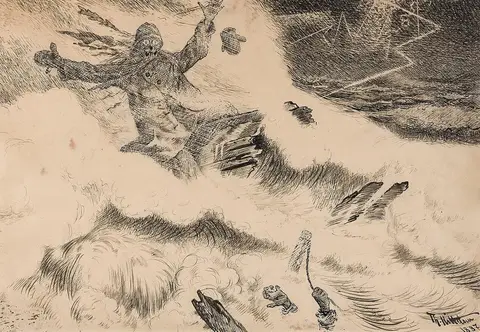
The soucouyant is a figure of Caribbean folklore, found under many names – Ol’ Higue in Jamaica and Guyana, asema in Suriname, hag in the Bahamas and Barbados, soukouyan in Grenada, and loogaroo elsewhere. By day it looks like a reclusive old woman or man; by night, the story goes, it removes its skin, hides it in a mortar or jar, and flies as a ball of fire to find a sleeping victim.
It is said to enter houses through any crack or keyhole and to drink blood, leaving bruise-like blue marks by morning. A victim who loses too much blood may die, and in some tellings become a soucouyant. It is a type of jumbie or spirit and is sometimes described as a vampire.
The remedies are famous. Rice or grains scattered around the house, bed or crossroads force the creature to count each grain, and it is exposed at dawn. Salt or pepper rubbed on the hidden skin prevents the soucouyant from putting it back on. Written records exist from the late nineteenth and early twentieth centuries: M. Clavel’s 1904 article on Bahamian folklore and Elsie Clews Parsons’s 1918 collection from Andros recorded the Bahamian hag and its skin-shedding.
Some writers point to African and French influences, and local commentary notes that the tale was used to explain unexplained deaths, particularly of infants, and to keep children indoors after dark. After Trinidad and Tobago’s independence in 1962, the government promoted folk traditions such as soucouyant plays.
What does Soucouyant look like?
An old, reclusive person by day; by night a flying fireball that has shed its wrinkled skin, with glowing eyes.
Where is Soucouyant seen?
Villages and homes in Trinidad and across the Caribbean, particularly at night, with the skin hidden in a mortar or jar.
Soucouyant sightings
- 1904Clavel on the Bahamian hag The Bahamas
M. Clavel’s “Items of Folk-lore from Bahama Negroes” recorded that when a hag enters a house she sheds her skin.
- 1918Folk-tales of Andros Island Andros, Bahamas
Elsie Clews Parsons repeated the account and noted that hags could also be men.
- 1962Folklore preserved after independence Trinidad and Tobago
After independence, Prime Minister Eric Williams began programmes to preserve folk customs, including dramatisations of the Soucouyant.
Is Soucouyant real? What could explain it
- The legend is a folk tale and not a reported creature, used to explain wasting illness and infant deaths in times of limited medical knowledge.
- Sleep paralysis and night-time anxieties are often cited as underlying experiences behind skin-shedding witch and “night hag” stories worldwide.
- Fireballs seen at night may have been fireflies, marsh gas or burning cane.
Legend, culture and tourism
The soucouyant features in plays, storytelling, and festivals across Trinidad and Tobago, Guyana, Jamaica and the French Caribbean.
Where it’s reported
Sources
First published · Updated