FIELD FILE · NEBRASKA-MANHOMINIDHOAX / DEBUNKED
Nebraska Man
Also known as Hesperopithecus haroldcookii, Western ape
A supposed American ape-man announced in 1922 from a single fossil tooth found in western Nebraska – which turned out to belong to an extinct peccary.
Nebraska Man was never a monster in the woods, but for a few years in the 1920s it was North America’s claim to a prehistoric ape. The whole case rested on one worn fossil tooth, collected in 1917 by rancher and geologist Harold Cook from the Snake Creek beds of western Nebraska, near his family’s Agate Springs ranch.
In March 1922 Cook sent the tooth to Henry Fairfield Osborn, the influential president of the American Museum of Natural History in New York. Osborn and his colleagues concluded it was the molar of a manlike ape, and in April 1922 he named it Hesperopithecus haroldcookii – “Harold Cook’s ape of the western world” – the first higher primate ever reported from the Americas. He sent casts to more than two dozen institutions.
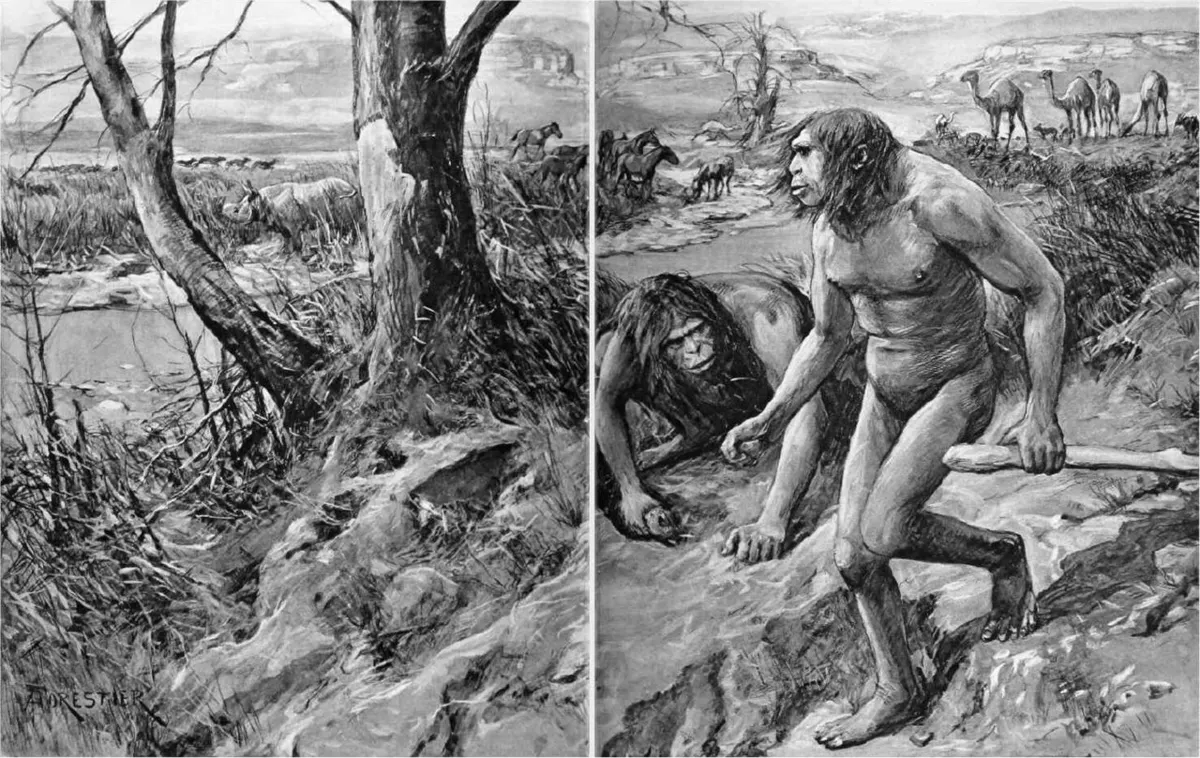
The find’s public image came from London. On June 24, 1922, the Illustrated London News published a full-page reconstruction by artist Amédée Forestier showing a pair of hairy, upright ape-people, alongside an article by British anatomist Grafton Elliot Smith, who embraced the tooth as a possible human ancestor. Osborn himself dismissed the drawing as imaginative and of no scientific value, and many specialists, including Arthur Smith Woodward and Marcellin Boule, doubted the identification from the start.
Fresh digging at the site in 1925 and 1926 turned up more bones, and they told a different story. At the end of 1927 Osborn’s colleague William King Gregory published a retraction in Science: the tooth came from an extinct peccary, a pig-like animal, whose unusual wear had made it look like an ape’s. Nebraska Man has lived on mainly as a cautionary tale – cited by creationists as proof of scientific error and by scientists as an example of the field correcting itself.
- Type
- Hominid
- Status
- Hoax / debunked
- First reported
- 1922
- Best-known location
- Snake Creek fossil beds, western Nebraska
- Also called
- Hesperopithecus haroldcookii, Western ape
- Reported in
- Nebraska
What witnesses describe
Known only from one heavily worn cheek tooth. The famous image of a hairy, stooping ape-man and ape-woman comes entirely from Forestier’s 1922 magazine illustration, which was based on the proportions of Java Man rather than on any Nebraska fossil.
Where and when it’s seen
The Miocene Snake Creek fossil beds of western Nebraska, near today’s Agate Fossil Beds National Monument – an area rich in the bones of extinct mammals such as rhinos, horses and peccaries.
Notable sightings
- 1917Harold Cook finds the tooth Snake Creek beds, western Nebraska
Rancher-geologist Harold Cook collected a small, worn fossil tooth from deposits that had already yielded many extinct mammals.
- April 1922Osborn names <em>Hesperopithecus</em> American Museum of Natural History, New York
Henry Fairfield Osborn announced the tooth as belonging to the first anthropoid ape known from the Americas and named it after Cook.
- June 24, 1922The <em>Illustrated London News</em> drawing London, England
Amédée Forestier’s reconstruction of Nebraska Man and his mate appeared with an article by Grafton Elliot Smith, giving the ape-man a face that far outran the evidence.
- 1927Retraction in <em>Science</em> New York
After further excavations in 1925–26, William King Gregory concluded that the tooth belonged to an extinct peccary, Prosthennops. Newspapers in New York and London reported the reversal in early 1928.
What could explain it?
- The tooth is now identified as an upper premolar of an extinct peccary; peccary and primate cheek teeth can look alike, especially when worn, and its rotation in the jaw had produced a primate-like wear pattern.
- Naming a new primate from a single eroded tooth was always a thin basis, and many scientists withheld judgment from the start.
- It was an honest misidentification, not a deliberate hoax; it is grouped with hoaxes only because the creature never existed.
- The popular image of Nebraska Man owed everything to an artist’s reconstruction and newspaper enthusiasm, not to any skeleton.
Legend, culture and tourism
Nebraska Man became a staple of the evolution–creation debate, often (inaccurately) said to have been used as evidence at the 1925 Scopes trial. Historians of science treat it as a classic case study in over-interpreting fragmentary fossils. Agate Fossil Beds National Monument, near where the tooth was found, now interprets the region’s genuine Miocene mammals and the Cook family’s ranch.
Places to visit
A National Park Service site on Harold Cook’s former ranch, with trails to Miocene bone beds and a visitor center of fossil mammals.
Where it’s reported
Nebraska Man in the news
No recent headlines about the Nebraska Man. Our news desk checks every day — see all cryptid news.
Sources
First published · Updated