FIELD FILE · EL-SILBONSPECTRALFOLKLORE
El Silbón
Also known as The Whistler, El Silbador
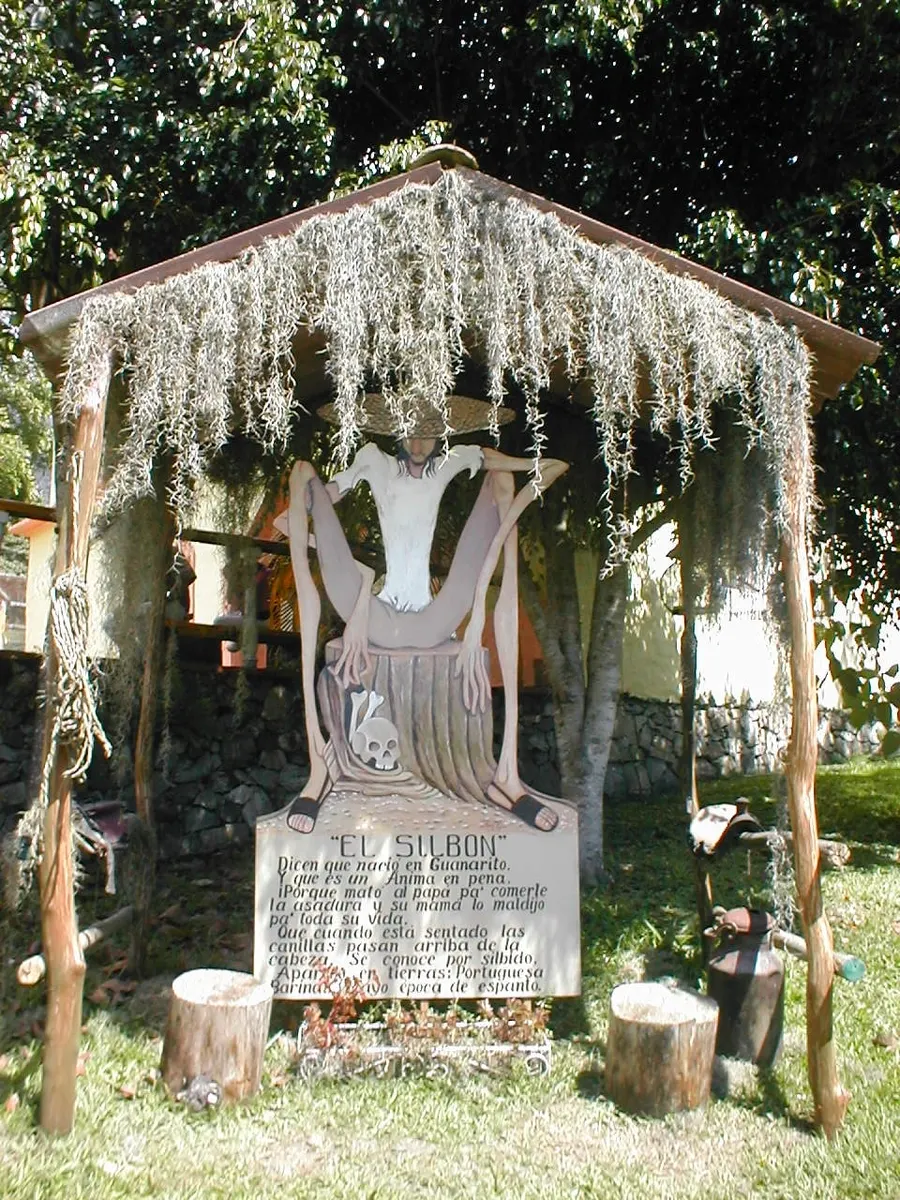
A towering, cursed phantom of the Llanos who carries his father’s bones in a sack – and whose whistle is most dangerous when it sounds far away.
Los Llanos are the vast tropical grasslands shared by Venezuela and Colombia: flat cattle country that floods in the rainy season and scorches in the dry one, where cowboys (llaneros) ride for days between ranches and the nearest neighbour may be hours away. It is a landscape built for ghost stories told around a fire, and its most feared ghost is El Silbón, “the Whistler.”
The tale is usually traced to the plains around Guanarito, in Venezuela’s Portuguesa state, and is thought to have taken shape in the mid-19th century. In the best-known version, a spoiled young man demands deer offal for dinner. When his father comes home from the hunt empty-handed, the son kills him in a drunken rage and brings his entrails home for his mother to cook. When the crime is discovered, the grandfather has him tied up and whipped, rubs chili or strong liquor into his wounds, sets hungry dogs on him and curses him to wander for eternity carrying his father’s bones in a sack. Other versions change the motive – in one, the father had abused the son’s wife – but the curse is always the same.
What makes El Silbón memorable is the rule about his whistle, which climbs up a musical scale. If it sounds close by, there is nothing to fear, because he is far away; if it sounds distant, he is right beside you. Storytellers say he punishes drunkards and womanizers, sometimes sits outside a house at night counting the bones in his sack, and flees from a barking dog, a whip or hot chili pepper.
Like many Latin American apparitions, El Silbón works as a moral lesson as much as a monster: a warning against disrespecting parents, drinking and roaming the plains at night. Some folklorists have suggested the story was also a convenient way to keep farmhands home after dark. Across the border in Colombia’s Eastern Plains he is told in a gentler form, as a lonely man who whistles for company and whose call foretells a death.
- Type
- Spectral
- Status
- Folklore
- First reported
- Mid-19th century
- Best-known location
- Los Llanos of Venezuela and Colombia
- Also called
- The Whistler, El Silbador
- Reported in
- Venezuela Colombia
What witnesses describe
An extremely tall, thin man – in some tellings as tall as the treetops, about six metres – in ragged clothes and a broad straw hat, carrying a dirty sack of bones over his shoulder. Often he is only heard: a slow, rising whistle running through the notes of the scale.
Where and when it’s seen
The open savannas, gallery forests and riverbanks of the Venezuelan and Colombian Llanos, especially on dark, humid nights in the rainy season and around ranch houses after midnight.
Notable sightings
- Mid-19th centuryThe legend takes shape Guanarito, Portuguesa, Venezuela
Folklorists generally place the origin of the story on the plains of Guanarito in the mid-1800s, from where it spread across the Venezuelan Llanos and into Colombia’s eastern plains. The date is approximate, as the tale circulated orally.
- 2018<em>El Silbón: Orígenes</em> reaches cinemas Venezuela
Director Gisberg Bermúdez’s horror film built on the legend premiered in Venezuela and won Best Ibero-American Feature at Buenos Aires Rojo Sangre. It was released in the United States in 2019 as The Whistler.
What could explain it?
- El Silbón is a folk tale rather than a reported animal: it carries moral lessons about family duty, drinking and infidelity, much like La Llorona elsewhere in Latin America.
- The plains at night are full of strange calls – nocturnal birds such as potoos and nightjars produce eerie, whistling notes that a frightened listener could easily attribute to a ghost.
- The rule that a distant whistle means danger may reflect real acoustic confusion: sound carries unpredictably over flat, humid grassland, making it hard to judge distance.
- Some scholars see the story as a form of social control, discouraging labourers from wandering or stealing cattle after dark.
Legend, culture and tourism
El Silbón is one of the best-known espantos (frights) in Venezuelan folklore, retold in schools, llanero songs and campfire storytelling, and it is equally familiar in Colombia’s Eastern Plains. Statues and costumed figures of the Whistler appear in folklore parks, and the legend has inspired horror films and online storytelling, introducing it to audiences far beyond the Llanos.
Where it’s reported
Venezuela Colombia Portuguesa Barinas Apure Casanare Meta Arauca
El Silbón in the news
No recent headlines about the El Silbón. Our news desk checks every day — see all cryptid news.
Sources
First published · Updated