Field file · Hominid · Local legend
Caddo Critter
Also known as Haskell Rascal, Hawley Him
A seven-foot, gorilla-like creature reported near the ghost town of Caddo, Texas, in July 1964 that drew armed searchers, hoaxes and a yak theory.
In the summer of 1964 a gorilla-like creature turned up in the news of Stephens County, Texas, in the ranch country between Breckenridge and Mineral Wells. The reports centered on Caddo, a ghost town off U.S. Highway 180. The University of North Texas Libraries’ Yesterday’s News blog, which revisited the coverage in 2026, calls the animal the Caddo Critter.
On July 18, 1964, according to the UNT blog’s account of the newspaper coverage, a 72-year-old rancher named Charlie Gantt said he saw a creature more than seven feet tall that looked like a gorilla. He fired a .22 revolver nine or ten times without bringing it down. Local people called him an honest man. Others stepped forward: John Mitchell, 40, said it had circled his trailer house and tangled with his dog, and his wife said she saw it too; nine-year-old Gene Couch said it bared its teeth and growled by a pond. Residents gathered with guns to hunt it. In nearby Haskell, people said a similar animal had been seen within a sixty-mile radius, and the name “Haskell Rascal” was used for it.
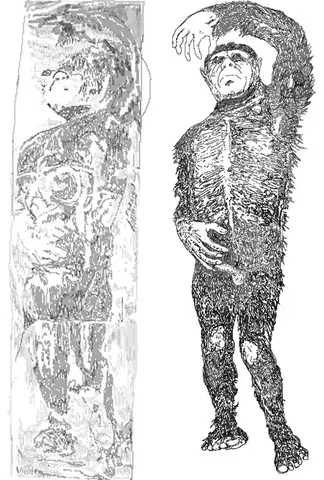
The story also became a joke. A boy from Arlington thought he had photographed the beast but learned his friends had staged the picture. A local man published a mock letter supposedly written by the Caddo Critter that taunted a rival “Milam County Monster.” On July 24, 1964, Bob Cooke of the Abilene Reporter-News printed a sketch of what the culprit might look like. Skeptics pointed to an escaped zoo or game-preserve animal, and farmer Harold Cook said he thought it was a yak; deer hunter Bobby Wilson reported seeing a yak grazing with Cook’s livestock.
A similar creature returned in 1977 in Hawley, Texas, about eighty miles west. A local woman, Renee Miller, later recalled that on July 7, 1977, two teenage boys clearing land for an electric fence said something was throwing rocks at them; she described a seven-foot, long-haired figure with a rotten-egg smell, and a Texas oilman reportedly offered a $5,000 reward for its capture. Locals called it the “Hawley Him,” and some wondered whether the same animal was moving between towns.
What witnesses describe
A gorilla-like or ape-like animal more than seven feet tall, covered in hair, with bared teeth and a growl; in 1977 versions, a long-haired figure with a rotten-egg smell that threw rocks.
Where and when it’s seen
Brush, ranch land, ponds and thickets in Stephens, Haskell and neighboring counties of West-Central Texas, mainly in summer.
Notable sightings
- July 18, 1964Charlie Gantt’s gorilla Caddo, Stephens County, Texas
Rancher Charlie Gantt, 72, said he saw a gorilla-like creature over seven feet tall and fired a revolver at it repeatedly with no effect. Armed residents began to search.
- July 24, 1964The Abilene sketch Abilene Reporter-News
The newspaper printed a sketch of what its artist thought the creature looked like, while skeptics proposed an escaped animal or a yak.
- July 7, 1977The Hawley Him Hawley, Texas
Teenagers clearing land said something threw rocks at them; one witness later recalled a seven-foot, long-haired creature and a rotten-egg smell.
What could explain it?
- Local farmers suggested a yak: a deer hunter said he saw one grazing with a farmer’s cattle, and an animal that large could be taken for a gorilla at dusk.
- Escaped zoo or private-preserve animals were also proposed, since a game preserve existed at nearby Possum King Lake.
- Hoaxes and jokes fed the story, including a staged photograph and a mock letter from the “critter.”
- Rumor spreads quickly in small towns after a first scare, which could explain the similar reports in neighboring communities in 1964 and again in 1977.
Legend, culture and tourism
The Caddo Critter is a small-town West Texas legend best known today through the University of North Texas Libraries’ Yesterday’s News blog and the digitized newspapers in the university’s Portal to Texas History. It should not be confused with the swamp creatures of East Texas’s Caddo Lake, hundreds of miles away; the name comes from the Stephens County ghost town.
Places to visit
UNT’s free digital library holds digitized Texas newspapers and photographs, including local coverage from the era of the Caddo Critter.
Where it’s reported
Sources
First published · Updated