FIELD FILE · AGROPELTEROTHERFOLKLORE
Agropelter
Also known as Argopelter, Anthrocephalus craniofractens, Widow-maker
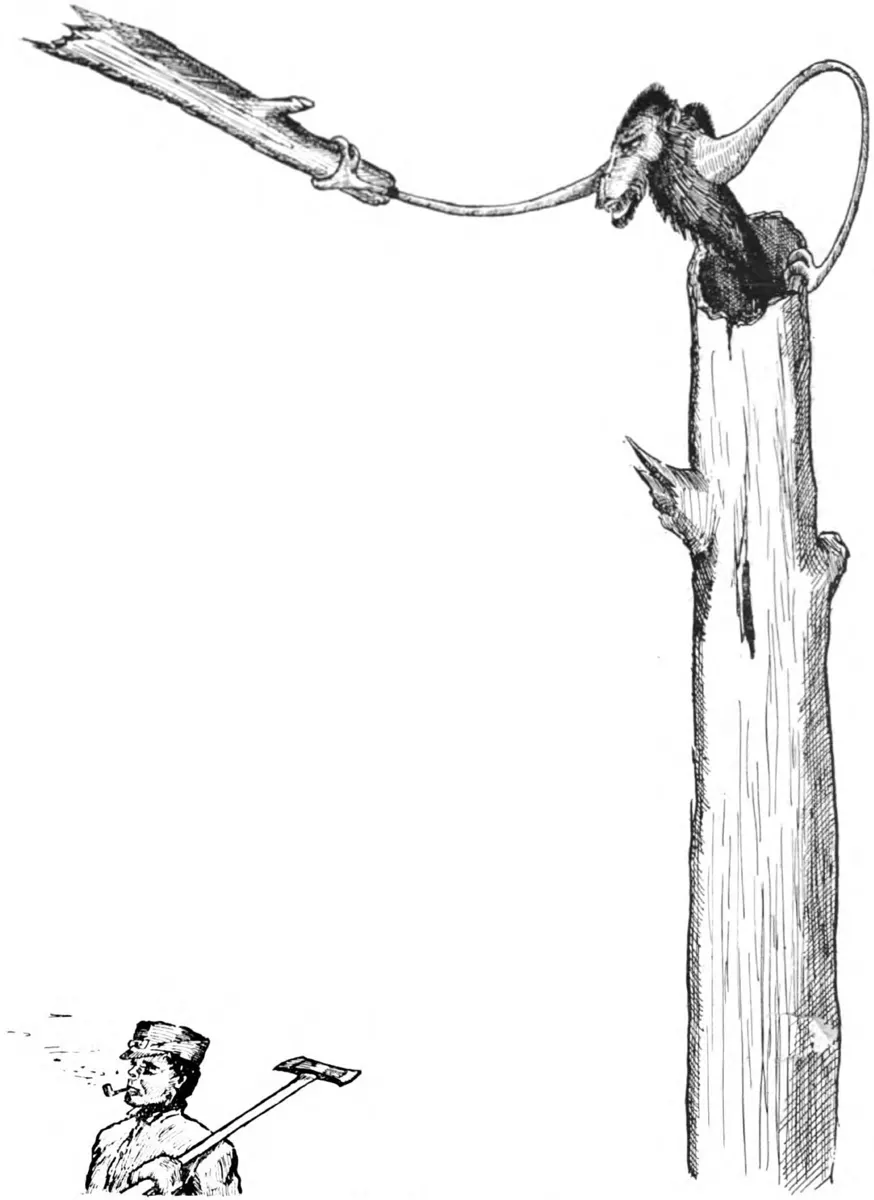
A wiry, ape-faced lumberwoods critter that hides in hollow trees and hurls dead branches at loggers – blamed for every “widow-maker” limb that fell.
The agropelter is the fearsome critter that explains falling branches. In the tall tales of North American lumber camps it lives inside hollow, rotting trees in the conifer forests – the lore places it anywhere from Maine to Oregon – and waits for a logger to pass below. Then, with arms like whiplashes, it snaps off a dead limb and flings it down with deadly accuracy.
Its best-known written portrait comes from William T. Cox’s Fearsome Creatures of the Lumberwoods, With a Few Desert and Mountain Beasts (1910), a tongue-in-cheek field guide by a forester who went on to become Minnesota’s first state forester. Cox gave the creature the mock Latin name Anthrocephalus craniofractens – roughly “man-head skull-breaker” – and claimed he could find only one man who had survived an attack: Big Ole Nittleson, who was cruising timber on the upper St. Croix River when a limb hurled by an agropelter struck him. The branch was so rotten that it shattered on his head, and Ole got a look at the culprit before it bounded away.
According to Ole’s description, the agropelter has a thin, sinewy body, the face of a villainous ape and long, muscular arms, and Cox added that it feeds on hoot owls and woodpeckers – whose scarcity, he wrote, keeps it from ever becoming common. Later writers, especially Henry H. Tryon in Fearsome Critters (1939), added further flourishes, and the Bangor Daily News has called it the most fearsome of the Maine beasts in Cox’s book.
The joke has a grim edge. Dead branches that break loose and fall on workers – still called “widow-makers” in forestry – were a real and frequent cause of death in the woods. Blaming an invisible, spiteful creature for them was one way logging crews turned danger into dark humor.
- Type
- Other
- Status
- Folklore
- First reported
- 1910
- Best-known location
- Northern conifer forests, from Maine to Oregon
- Also called
- Argopelter, Anthrocephalus craniofractens, Widow-maker
What witnesses describe
A slender, wiry animal with an ape-like, sometimes skull-pale face, a shaggy dark body and extremely long, muscular arms that it uses like whips to tear off and hurl branches.
Where and when it’s seen
Hollow dead trees in conifer forests across northern North America, especially near active logging; it strikes from above while loggers are at work.
Notable sightings
- 1910Fearsome Creatures of the Lumberwoods Washington, D.C.
William T. Cox published his illustrated guide to lumber-camp monsters, with drawings by Coert du Bois and mock Latin names by Forest Service dendrologist George B. Sudworth. The agropelter is one of its stars.
- 1939Tryon’s Fearsome Critters Cornwall, New York
Henry H. Tryon’s later field guide retold the agropelter’s habits for a new generation, cementing it in fearsome-critter lore.
What could explain it?
- The agropelter is a humorous invention of logging-camp storytellers, written up by foresters with tongue firmly in cheek.
- It personifies a real hazard: dead limbs (“widow-makers”) dislodged by wind or by felling work, which killed and injured many loggers.
- Owls and woodpeckers – the agropelter’s supposed diet – really do nest in the hollow dead snags where it was said to lurk.
Legend, culture and tourism
One of the classic fearsome critters of American lumberjack lore, the agropelter appears in Cox’s 1910 book (now in the public domain and recorded by LibriVox), in Tryon’s 1939 guide, in Maine folklore features, and in modern fantasy fiction, games and art.
Where it’s reported
Maine Minnesota Oregon Wisconsin
Agropelter in the news
No recent headlines about the Agropelter. Our news desk checks every day — see all cryptid news.
Sources
- Bangor Daily News: In the Maine woods, beware the tote-road shagamaw, billdad and agropelter (2020)
- A Book of Creatures: Agropelter
- Wikisource: Fearsome Creatures of the Lumberwoods (William T. Cox, 1910), full text
- LibriVox: Fearsome Creatures of the Lumberwoods by William T. Cox (public-domain recording)
- Wikipedia: Agropelter
First published · Updated