FIELD FILE · PIASA-BIRDFLYINGREGIONAL LEGEND
Piasa Bird
Also known as Piasa, Piesa, The Bird That Devours Men
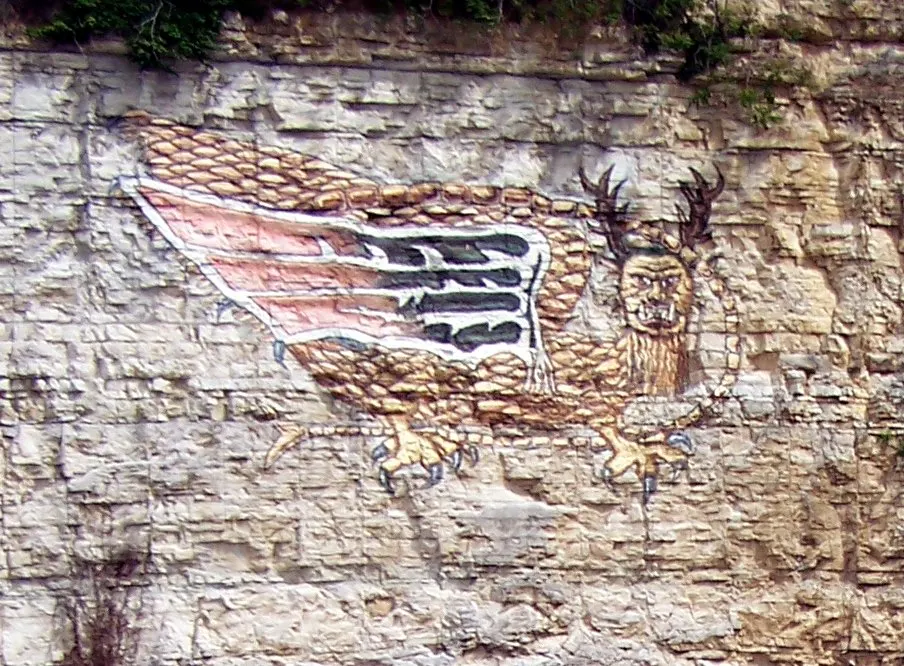
A winged, horned, man-faced monster painted on the Mississippi bluffs at Alton – first seen by Marquette in 1673 and reinvented by a storyteller in 1836.
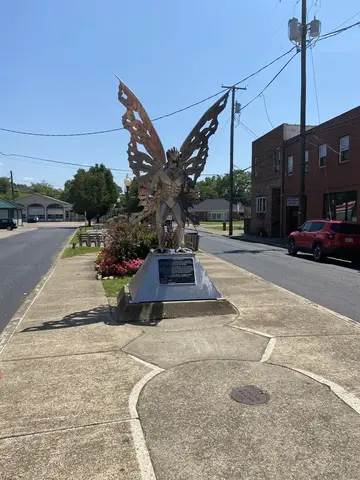
The Piasa Bird (usually pronounced “PIE-a-saw”) is the painted monster of Alton, Illinois. Today a brightly colored creature with wings, antlers, a bearded human face, scales and a long tail that wraps around its body stares out from a limestone bluff above the Great River Road, just upstream from where the Illinois and Missouri rivers meet the Mississippi. It is a modern recreation of a Native American rock painting that European travelers described more than 350 years ago – and the story attached to it is a fascinating mix of real history, lost art and 19th-century invention.
The earliest record comes from the 1673 voyage of Louis Jolliet and Father Jacques Marquette down the Mississippi. Marquette wrote of two painted monsters high on a rock face that startled his companions: each about the size of a calf, with horns like a deer, red eyes, a tiger-like beard, a face somewhat like a man’s, a scaly body and a tail so long it looped over the head and ended in a fish’s tail. Crucially, he said nothing about wings. A sketch made on the expedition appears to survive on a 1678 map by the French cartographer Jean-Baptiste-Louis Franquelin, which shows a wingless, four-legged beast.
Many scholars now identify the original figures with the underwater panther – a powerful water being found in the traditions of the Illinois (Illini), Miami, Ojibwe and other nations of the Great Lakes and Mississippi Valley – rather than with any bird. Later French visitors reported that Native people made offerings at painted rocks along this stretch of river, a reminder that the images had spiritual meaning long before they became a tourist attraction. The name itself is debated: suggestions range from an Illinois word for a panther-like being to a term for the “little people” of the water, while the bluffs were already marked “Piasas” on 18th-century maps.
The “bird” arrived in 1836, when writer John Russell published a dramatic tale claiming the name meant “the bird that devours men.” In his story the monster carried off villagers until a chief named Ouatoga offered himself as bait while hidden warriors shot it with poisoned arrows. Historians, including Wayne C. Temple in a detailed 1956 study, concluded that the tale was Russell’s own fiction, and Alton author Troy Taylor has put it more bluntly: Russell simply made it up. Winged pictures published later in the 19th century sealed the new image in the public mind.
The original painting did not survive. The bluff was quarried for limestone in the mid-1800s, and accounts differ on exactly when the last traces vanished. Alton has repeatedly brought the Piasa back: brothers Herbert and Orland Forcade painted a version in the 1920s that was lost when the road was widened, a painted steel panel was bolted to the cliff in the 1980s and taken down in 1995, and the current mural – roughly 48 feet long and 22 feet tall – was painted in the late 1990s under artist Dave Stevens. It needs regular upkeep, and in 2007 it had to be cleaned after vandals hurled tar-soaked sticks at it.
- Type
- Flying
- Status
- Regional legend
- First reported
- 1673
- Best-known location
- Mississippi River bluffs, Alton, Illinois
- Also called
- Piasa, Piesa, The Bird That Devours Men
- Reported in
- Illinois
What witnesses describe
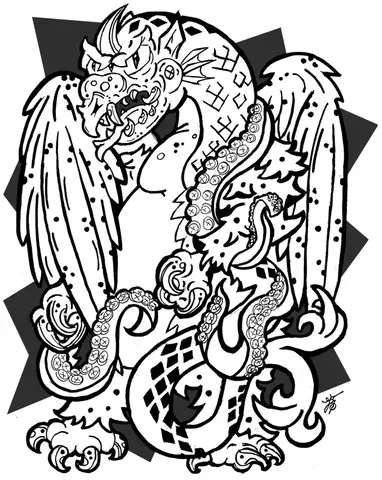
In its modern form: a creature with large bat- or bird-like wings, deer-like antlers, red eyes, a fierce bearded human face, a scaly body, talons, and a very long tail that coils around the body and ends in a fish’s tail, painted in red, black and green. Marquette’s 1673 description has the same face, horns, beard, scales and looping tail, but no wings.
Where and when it’s seen
The limestone bluffs of the Mississippi River at Alton, Illinois, along the Great River Road (Illinois Route 100). In Russell’s tale the creature lived in a cave in the bluffs, and the caves behind the modern painting were in fact cut by 20th-century lime quarrying.
Notable sightings
- 1673Marquette and Jolliet see the painted monsters Mississippi River bluffs near present-day Alton, Illinois
Paddling down the Mississippi, the French expedition passed two large painted monsters high on the rock face. Marquette described their horns, beards, human-like faces, scales and fish-tipped tails, and noted that the paintings were skillfully made.
- 1678The monster appears on a map France (map of the Illinois Country)
Cartographer Jean-Baptiste-Louis Franquelin included a small drawing of a wingless, panther-like beast at the location on a map of Jolliet’s discoveries – probably copied from a sketch made on the voyage.
- 1836John Russell invents the man-eating bird Illinois
Russell’s story of a winged monster that preyed on the Illini until the chief Ouatoga lured it to its death gave the creature its enduring name and image. Later researchers concluded the legend was largely his invention.
- 1920sThe Forcade brothers repaint the Piasa Alton, Illinois
Local brothers Herbert and Orland Forcade painted a large Piasa on the bluff that became the standard modern image. It was destroyed when the river road was widened around 1950.
- June 2007Vandals tar the mural Piasa Park, Alton, Illinois
Five local high school students confessed to throwing tar-dipped sticks at the painting. The city arranged a cleanup with dry ice blasting, and artist Dave Stevens planned to retouch faded sections.
What could explain it?
- The original paintings were real Native American rock art; scholars widely interpret them as underwater panthers, powerful water beings in regional Indigenous traditions, not a living animal.
- The man-eating “bird” and the tale of Ouatoga are generally regarded as 19th-century literary inventions by John Russell, later embellished by other writers.
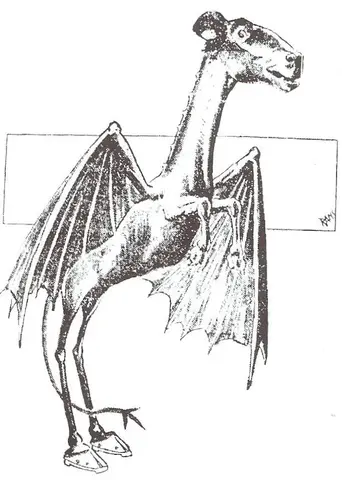
- The wings appear only in 19th-century reconstructions; some commentators think they were borrowed from European dragon imagery.
- Some modern writers link the legend to pterosaurs or giant birds, but there is no physical evidence, and Marquette’s own description does not include wings.
Legend, culture and tourism
The Piasa is Alton’s emblem: it has appeared on postcards, matchbooks and Scout patches, serves as a local school mascot, and anchors Alton’s many local legends. Behind the tourist image lies the deeper tradition of the underwater panther and other water beings in the beliefs of the Illinois Confederacy and neighboring nations – a living cultural heritage that deserves to be understood on its own terms rather than as a monster story.
Places to visit
The modern painting looks down on a small riverside park with parking and historical markers, a short drive north of downtown Alton.
The great Mississippian city across the river offers context for the region’s ancient Native American art and imagery.
Where it’s reported
Piasa Bird in the news
No recent headlines about the Piasa Bird. Our news desk checks every day — see all cryptid news.
Sources
First published · Updated