Field file · Lake & sea monster · Hoax / debunked
Omaha River Serpent
Also known as Missouri River Serpent of 1885, Omaha Bridge Serpent
A 50-foot serpent that the Omaha Daily Bee said jammed the Union Pacific bridge on April 1, 1885, a prank the paper admitted in its own story.
The Omaha River Serpent is one of Nebraska’s best-documented monsters because its creator confessed in print within hours. On April 2, 1885, readers of the Omaha Daily Bee opened their paper to a story headlined “A River Serpent,” describing a “Wonderful Sight Witnessed in the Missouri Yesterday.” At about eight o’clock the previous morning, the paper claimed, riverside residents had spotted a large black object floating down the river that turned out to be a genuine serpent, which the Bee gave a mock-scientific Latin name.
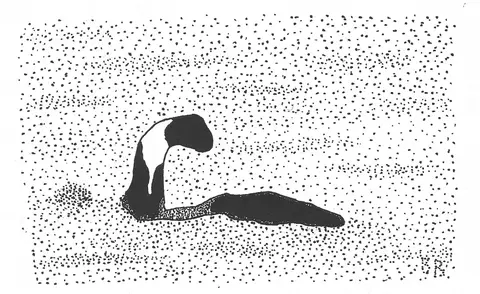
The paper’s description was magnificently over the top. The creature was about fifty feet long, with black skin covered in light-blue scales roughly two feet across, a body that tapered to a five-foot neck, upright ears eighteen inches long, a cavernous mouth full of ivory teeth, huge glassy red eyes, and a short tail finned and ending in a shape like a Maltese cross. A mock committee of inspection, including the coroner and the mayor, was said to have rowed out to examine it, and the coroner kept the data in case an inquest were needed.
Then came the bulletins. At 12:30 p.m. the serpent was said to be at the foot of Davenport Street, heading for shore, and spectators were rushing for gallery seats. By two o’clock it was wedged between the piers of the Union Pacific railroad bridge, and the railroad had dispatched a wrecking train to clear the debris once the structure fell. At 2:30 it was grunting in a noise like a cross between a foghorn and a railroad band; at 3:20 the bridge’s demolition was expected any minute. The final bulletin, at 4:00 p.m., reads simply: “This is an ‘April Fool’ lie.”
The hoax is a good example of Victorian newspaper humor, and the Nebraska State Historical Society, now History Nebraska, has written it up alongside the state’s other famous fictional beast, the “sea monster” of Walgren (formerly Alkali) Lake near Hay Springs, which was reported in 1923 and is also widely suspected to have started as a prank.
What witnesses describe
As described by the Bee: about 50 feet long, black skin with scales roughly two feet across and a light blue tint, a neck about five feet thick tapering from the body, two upright ears 18 inches long, an ivory-toothed mouth, flaming red glassy eyes, and a short finned tail ending in a cross-like shape.
Where and when it’s seen
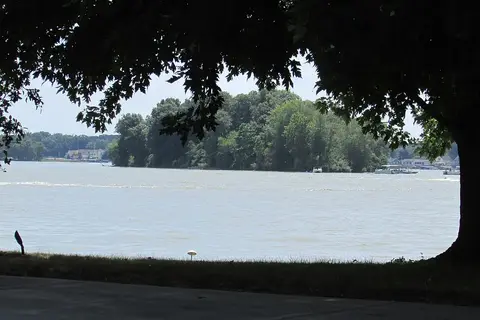
The Missouri River near Omaha, in the story drifting downriver in the morning and lodging at the Union Pacific railroad bridge that crossed to Council Bluffs, Iowa, by afternoon.
Notable sightings
- Morning, April 1, 1885The black object upriver Missouri River above Omaha
By the Bee’s account, riverside watchers saw a huge black form float down the river around 8 a.m. and guessed it was a dime-museum whale, a giant shoe or a horse’s tail before settling on a serpent.
- Afternoon, April 1, 1885Stuck at the Union Pacific bridge Omaha, Nebraska
A series of timed bulletins put the serpent at the foot of Davenport Street, then wedged between the stone piers of the Union Pacific bridge, threatening to bring it down.
- April 2, 1885“An April Fool lie” Omaha, Nebraska
The Bee’s final bulletin, timed 4:00 p.m., admitted the whole story was an April Fools’ joke. The paper printed it in its April 2 edition.
What could explain it?
- Intentional hoax: the Bee’s own last bulletin calls it an April Fools’ lie, and the story’s tongue-in-cheek names, mock committee and escalating bulletins mark it as humor.
- April Fools’ tradition: American newspapers of the 1880s often printed fake wonders on April 1, and the Bee’s deadpan scientific language and timed bulletins are typical of the genre.
- Real inspiration: floating logs and snags on the Missouri are common, and a huge cottonwood trunk drifting downriver could pass for a serpent at a distance.
Legend, culture and tourism
The serpent has no festival or statue, but it is remembered by History Nebraska, the state historical society, as a piece of Nebraska’s tradition of fictional monsters. Nebraska’s better-known lake monster, the Walgren Lake Monster of Hay Springs, was likewise largely the work of tall-tale writers, and Mari Sandoz wove it into her book Old Jules.
Places to visit
A museum in Omaha’s historic Union Station, a good place to explore the city’s railroad and Western history.
Where it’s reported
Sources
First published · Updated