FIELD FILE · MENEHUNEHUMANOIDFOLKLORE
Menehune
Also known as Nā Menehune, Manahune
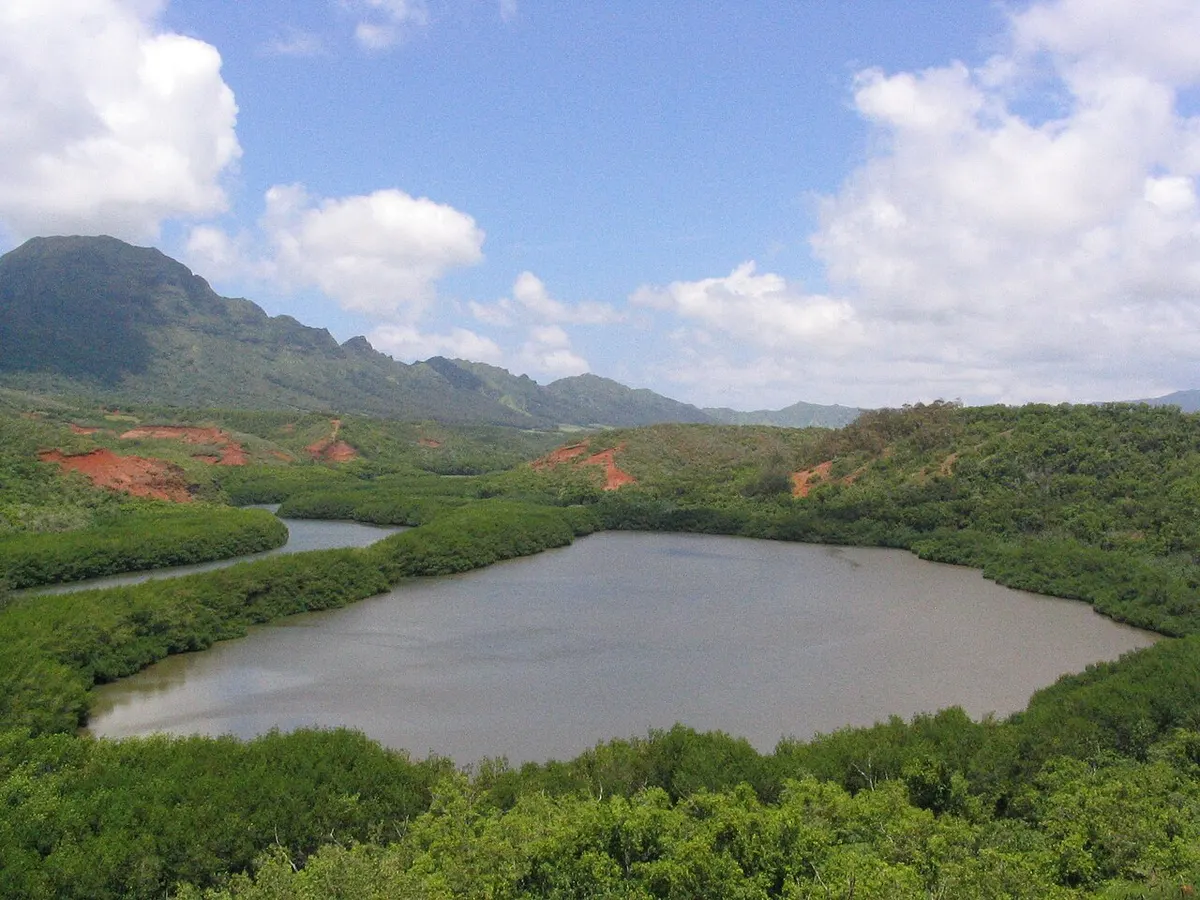
The legendary master builders of Hawaiian tradition, said to raise fishponds and stone walls in a single night – still debated by Hawaiian scholars today.
In Hawaiian moʻolelo (traditional history and story), the Menehune are a people of extraordinary builders. They are usually described as small, strong and shy, living in remote forests and valleys, and working only at night. Given a task, they would form long lines and pass stones hand to hand, finishing a fishpond, a heiau (temple) or an irrigation channel before dawn – and if the work was not done by sunrise, or if anyone watched them, they would leave it unfinished.
The most famous examples are on Kauaʻi. The ʻAlekoko Fishpond near Nāwiliwili, an ancient aquaculture pond enclosed by a long lava-rock wall, is said to have been built in one night by Menehune passing stones in a line from Makaweli, some 25 miles away. In one telling, two royal siblings broke the rule against watching, the Menehune stopped work, and they washed their scraped, bleeding hands in the water. At Waimea, the finely cut, fitted stones of Kīkīaola – the “Menehune Ditch” – are credited to them as well, and on Oʻahu oral tradition links them to heiau such as Ulupō in Kailua and Kūkaʻōʻō in upper Mānoa Valley.
Who the Menehune were is a real and lively question in Hawaiian scholarship. Bishop Museum director Te Rangi Hiroa (Sir Peter Buck) thought they might be memories of early settlers who were later absorbed or displaced. Folklorist Katharine Luomala, in a 1951 Bishop Museum study, argued that the name came from the Tahitian word manahune, meaning commoners or people of low rank rather than small stature, and that the hard-working commoners who really built the old structures were transformed into a legendary race – with some help, after Western contact, from European tales of brownies and elves.
Many Native Hawaiians see the Menehune differently again: not as fairies but as a real people and distant relatives. Writing in Ka Wai Ola, the Office of Hawaiian Affairs newspaper, kumu Kalani Akana described them as a true lāhui (people) with genealogies in Hawaiian tradition, and noted that in an 1820 census on Kauaʻi, 65 people at Wainiha identified themselves as Menehune. Some Kauaʻi families still speak of Menehune ancestry. Archaeologists have found no evidence of a physically tiny population, but the Menehune remain an honored part of Hawaiian history and identity – very different from a monster.
- Type
- Humanoid
- Status
- Folklore
- First reported
- Pre-colonial
- Best-known location
- Kauaʻi and Oʻahu, Hawaiʻi
- Also called
- Nā Menehune, Manahune
- Reported in
- Hawaii
What witnesses describe
Most popular accounts describe them as short, stocky, muscular and darker-skinned, with great strength and skill; some traditions describe them simply as men. They are said to be shy and rarely seen, working in large organized groups at night. Hawaiian sources stress their craftsmanship rather than any frightening features.
Where and when it’s seen
Remote forested valleys and uplands, especially on Kauaʻi (Waimea, Wainiha, the Alakaʻi area) and Oʻahu (upper Mānoa and Nuʻuanu valleys). They are associated with ancient stone structures – fishponds, ditches, walls and heiau – and with night-time work.
Notable sightings
- 1820Menehune in the census Wainiha, Kauaʻi
During a census taken under Kauaʻi’s ruling chief Kaumualiʻi, 65 people at Wainiha were recorded as Menehune. Scholars still debate whether the term then referred to a social class, a lineage or the legendary people.
- 1930sThe Menehune wall of Mānoa Mānoa Valley, Oʻahu
In an interview recorded in the 1930s, Maka Woolsey described a “Menehune wall” that began at Kūkaʻōʻō Heiau and ran for miles, part of Mānoa’s rich Menehune traditions.
- 1951Luomala’s study Bishop Museum, Honolulu
Katharine Luomala’s The Menehune of Polynesia and Other Mythical Little People of Oceania argued that the legendary builders grew out of the Polynesian word for commoners. Her view remains influential but is contested.
- 1973ʻAlekoko Fishpond listed Nāwiliwili, Kauaʻi
The Menehune Fishpond was added to the National Register of Historic Places as one of the finest surviving examples of ancient Hawaiian aquaculture.
What could explain it?
- Folklorist Katharine Luomala argued that “menehune” derives from Tahitian manahune (commoners), and that the real builders – ordinary laborers organized by chiefs – became a legendary race in story.
- Te Rangi Hiroa (Sir Peter Buck) proposed that the Menehune remember an early wave of settlers, later absorbed or displaced.
- After Western contact, European ideas of elves and brownies probably reshaped the image of the Menehune as tiny, mischievous little people.
- Archaeology shows the structures were built by skilled Hawaiian communities using organized labor; no evidence of a physically diminutive population has been found.
Legend, culture and tourism
The Menehune are deeply woven into Hawaiian place names and moʻolelo, and many Hawaiians regard them as ancestors or relatives rather than as fantasy creatures. They have also become a popular symbol: school mascots on Kauaʻi and Oʻahu, a 1970s–80s airline advertising character, and even the name of the central computer of the University of Hawaiʻi’s pioneering ALOHAnet. Visitors should treat Menehune sites, especially heiau, as culturally significant places.
Places to visit
A roadside overlook above the ancient pond and the Hulēʻia National Wildlife Refuge; the pond itself is on protected and private land.
The fitted stone facing of this ancient irrigation channel is visible near the Waimea Swinging Bridge.
Home of Kūkaʻōʻō Heiau, which oral tradition links to the Menehune; visits are by guided tour.
Where it’s reported
Menehune in the news
No recent headlines about the Menehune. Our news desk checks every day — see all cryptid news.
Sources
First published · Updated