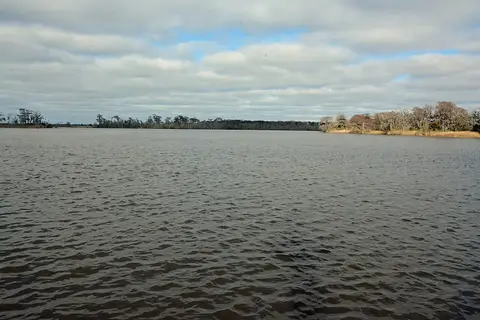
Field file · Lake & sea monster · Local legend
Connecticut River Serpent
Also known as Connecticut River Sea Serpent, Cromwell Serpent, Big Conn
In September 1886 two men in a skiff said a huge black-headed serpent struck their boat on the Connecticut River, and crowds soon lined the banks to watch.
Most American sea-serpent stories come from the open ocean, but in the late 1800s one turned up in a quiet stretch of New England river. In September 1886, according to a letter its author wrote to a newspaper, E. J. Stockwell of Cromwell, Connecticut, and a companion named Silas Sage were in a boat on the Connecticut River opposite Cromwell when something struck the stern. They said they then saw a huge serpent thrash the water, lift its head some ten feet into the air and open its mouth to show a red tongue. Other people, Stockwell wrote, had seen it too – including a sea captain, a clergyman and a Middletown oil dealer who was fishing near the Portland shore.
The newspapers were delighted. The New York Times is reported to have described a black head as big as a flour barrel and a creature of perhaps a hundred feet, and, according to modern retellings of the coverage, people sat along the banks hoping for a glimpse. Not everyone was convinced. A Middletown professor, William Brewer, was quoted as doubting the whole thing, and Stockwell wrote to rebut him, pointing out that the professor had been about three miles from the spot and had spoken to neither witness. He also dismissed the idea that the boat had merely struck a floating log. He added that two Middletown men fishing for eels near the steamboat dock three nights later heard a loud commotion in the dark water and rowed for shore.
Later reports kept the legend alive up and down the river. In 1894 a farmer named Austin Rice, who lived at East Deerfield in Massachusetts, described a dark serpent with a horse-sized head and a belly stripe that reared out of the river close to his land, according to a retelling of the newspaper account. Over a century later, in 1995, the Main Street Museum of White River Junction, Vermont, issued a deadpan press release about a river monster seen where the White River joins the Connecticut and declared it a cousin of Lake Champlain’s Champ. The museum’s humor shows how the legend has become a local in-joke as much as a belief.
The serpent belongs to a large family of nineteenth-century newspaper monsters. The 1886 reports appeared in the same weeks that other papers were running serpent stories, and the same page of one reprinting carried a report of a “sea serpent” at Gloucester, New Jersey. Whatever its truth, the Connecticut River serpent is a good example of how a single sensational letter could set off a local sensation.
What witnesses describe
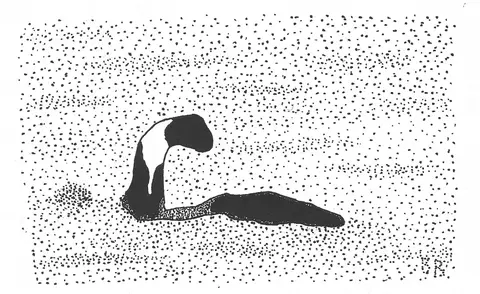
Witnesses in 1886 described a very long dark serpent whose head rose about ten feet above the water; the 1894 account added a stripe on the belly and a head about the size of a horse’s, and the creature was reported strong enough to swim against the current.
Where and when it’s seen
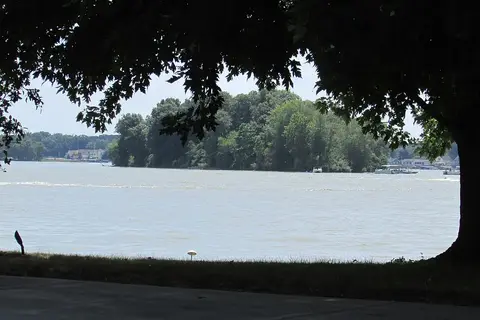
The lower and middle Connecticut River, with 1880s reports centered on the Middletown–Cromwell stretch and later ones upriver in Massachusetts and Vermont. Most reports date from late summer.
Notable sightings
- September 1886Stockwell and Sage’s encounter Connecticut River, opposite Cromwell
E. J. Stockwell and Silas Sage said a serpent struck their boat and raised its head about ten feet from the water. Stockwell wrote that several other people, including fishermen near Portland, saw it too.
- September 1886Disturbance at the Middletown steamboat dock Middletown, Connecticut
Three nights after the Cromwell report, two Middletown men fishing for eels said the river was violently disturbed in the dark and that waves rolled toward shore. They left before they could see what caused it.
- 1894Austin Rice at East Deerfield East Deerfield, Massachusetts
Farmer Austin Rice described a dark, thick-necked serpent that reared out of the river about twenty-five feet from him. Workmen nearby startled it and it swam off.
- 1995A museum’s press release White River Junction, Vermont
The Main Street Museum announced a monster seen where the White River meets the Connecticut, calling it a relative of Champ. The announcement was widely understood as humor.
What could explain it?
- Floating logs and driftwood could easily be mistaken for a long, dark creature, a possibility the original witnesses rejected but that a skeptic would raise first.
- Large fish such as sturgeon, a long eel, or a swimming deer or otter could have been exaggerated by excited observers on a murky river.
- The 1886 episode occurred during a wave of newspaper sea-serpent stories, and the Connecticut River account was spread by retelling – much of what is now repeated comes from secondary retellings of old clippings, not from original records.
- Some modern mentions are humor. The Main Street Museum’s 1995 release was a joke, and the Connecticut River Conservancy has run a playful April Fools’ post about a river serpent.
Legend, culture and tourism
The serpent is a small but fond part of Connecticut River Valley lore, sometimes grouped with Lake Champlain’s Champ and the sea serpent of Gloucester, Massachusetts. Local museums and conservation groups have used the monster to draw people to the river, while the story itself remains thinly documented and mostly rests on a handful of 1880s newspaper items.
Places to visit
Maritime museum on the lower river that tells the story of the Connecticut’s boats, trade and wildlife.
Eccentric curiosity museum that issued the 1995 river-monster press release.
Where it’s reported
Sources
First published · Updated