FIELD FILE · TRAUCOHUMANOIDFOLKLORE
Trauco
Also known as El Trauco
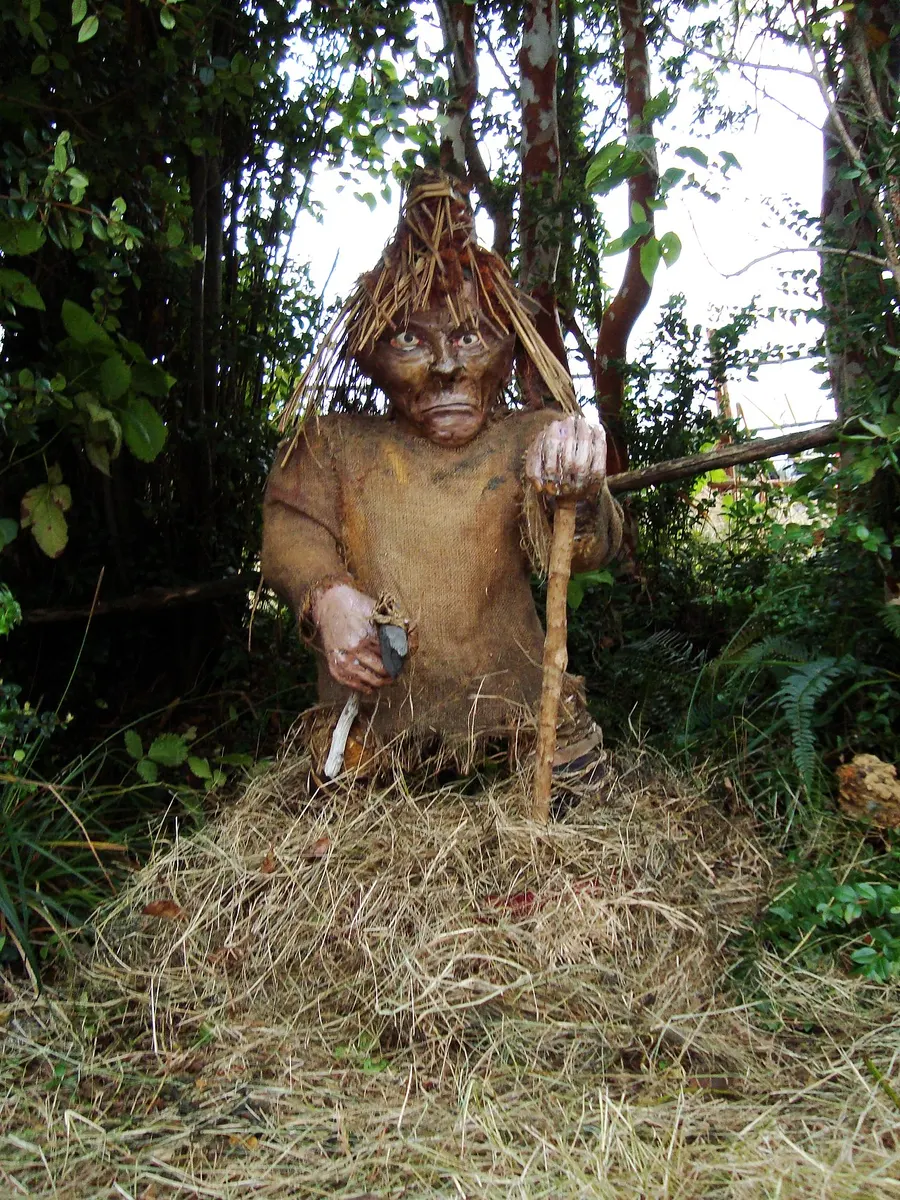
A stunted, footless forest man of Chiloé’s folklore who fells trees with a stone axe, curses men with a glance and is blamed for bewitching young women.
Chiloé is a rainy, green archipelago off the coast of southern Chile, famous for its wooden churches, stilt houses and a mythology unlike anything else in the country. Centuries of isolation blended the beliefs of the Huilliche (southern Mapuche) people with the folk Catholicism of Spanish settlers, producing a crowded supernatural world of sea spirits, witches, a ghost ship called the Caleuche – and the Trauco, the best-known creature of the island forests.
The Trauco is pictured as a small, ugly man, under a metre tall, with stumps instead of feet. He dresses in clothes and a conical hat woven from quilineja, a climbing plant of the Chilote rainforest, carries a twisted staff called a pahueldún, and owns a little stone hatchet that can fell any tree in three blows. Some tellings make him a child of Caicai Vilú, the sea serpent of the island’s origin myth, and give him a partner, the equally dangerous Fiura.
His powers are aimed at people. A man who surprises him can be left twisted, hunchbacked, mute or dying from a single look or breath. Young women, by contrast, are said to be drawn helplessly to him through dreams, and the Trauco was traditionally blamed when an unmarried woman became pregnant and no father came forward. Families protected their daughters with a handful of sand left on the table – the Trauco can’t resist counting the grains until dawn – or with crossed knives at the windows.
Folklorists see the legend as a social tool as well as a story: it shielded women and children from stigma in a tight-knit, Catholic rural society, while warning girls away from the woods. Modern Chileans increasingly point out its darker side – the myth could also be used to hide abuse – and the Trauco is discussed today as much in debates about gender and silence as in tales around the stove.
- Type
- Humanoid
- Status
- Folklore
- First reported
- Pre-colonial
- Best-known location
- Forests of the Chiloé Archipelago, southern Chile
- Also called
- El Trauco
- Reported in
- Chile
What witnesses describe
A short, stocky, ugly man of about 80 centimetres, with a coarse face and legs ending in stumps rather than feet. He wears a pointed hat and clothes woven from quilineja vine, and carries a crooked staff and a small stone axe. Some accounts say he can disguise himself as a bundle of firewood or a handsome young man.
Where and when it’s seen
The dense, damp native forests of Chiloé Island and the surrounding archipelago, living in hollow trees or small caves and feeding on the fruit of the quilineja.
Notable sightings
- 1914<em>Chiloé y los chilotes</em> Chile
Francisco Javier Cavada published his pioneering study of Chiloé’s folklore and dialect, one of the first serious attempts to document the islanders’ beliefs about creatures such as the Trauco.
- 1915Vicuña Cifuentes’s collection of Chilean myths Santiago, Chile
Julio Vicuña Cifuentes published Mitos y supersticiones recogidos de la tradición oral chilena, an early national collection of folk beliefs that includes entries on the Trauco.
What could explain it?
- The Trauco is a folk-tale figure, not a reported animal; no one claims him as a biological species.
- Anthropologists read the myth as a way for isolated communities to explain pregnancies outside marriage without shaming the mother or child.
- It also served as a warning to keep young women out of the forest – and critics note it could conceal sexual abuse within families or communities.
- Like other “little people” of world folklore, the Trauco combines Indigenous forest beliefs with European ideas of goblins and incubi brought by Spanish settlers.
Legend, culture and tourism
The Trauco is a symbol of Chiloé’s distinctive folk culture, along with the Pincoya and the Caleuche. Painted statues of him stand in the mythological corner of the Parque Municipal in Castro and elsewhere on the islands, and he is a fixture of souvenirs, school folklore lessons and Chilean storytelling.
Where it’s reported
Chile Los Lagos (Chiloé)
Trauco in the news
No recent headlines about the Trauco. Our news desk checks every day — see all cryptid news.
Sources
First published · Updated