Field file · Lake & sea monster · Local legend
St. Augustine Monster
Also known as Florida Monster, Octopus giganteus, Giant Octopus of St. Augustine
In late 1896 a huge gray carcass washed up near St. Augustine, Florida. A Yale zoologist called it a giant octopus, before taking it back.
In the last days of November 1896, two boys riding bicycles along the beach of Anastasia Island, across the bay from St. Augustine, Florida, came upon an enormous gray mass lying half buried in the sand. Accounts give the date as November 30 and name the boys as Herbert Coles and Dunham Coretter. The thing was shaped like a pear, many feet long and several feet wide, and it weighed several tons. Reports of its size vary from about 18 to about 21 feet in length.
Dr. DeWitt Webb, a local physician and the head of the city’s scientific society, took charge. He had horses and workers drag the carcass above the tide line, studied it, and noticed ridges along one side that looked to him like the stumps of huge arms. Convinced it was a gigantic octopus, he wrote to Addison E. Verrill, an authority on cephalopods at Yale. Verrill first guessed at a giant squid, then, working from photographs and descriptions, named it Octopus giganteus in 1897. The press loved the idea of an eight-armed sea monster, and the story reached newspapers far beyond Florida.
Verrill soon had second thoughts. After seeing more evidence, he published a correction in The American Naturalist in April 1897, concluding that the mass was most likely the decaying head of a sperm whale. That reversal received far less attention than the original announcement, and the sea monster lived on in popular memory. A January 1897 storm carried the carcass out to sea, from where it washed up again on Crescent Beach, before it was moved to another part of the island; its fate after that is not recorded.
The mystery was reopened in the twentieth century when samples held at the Smithsonian were tested. A 1971 study in Natural History, prompted by a Marineland curator and carried out with a University of Florida researcher, argued that the tissue looked like octopus; in 1986 the cryptozoologist Roy Mackal’s tests were read as consistent with a cephalopod. Then in 1995 a team led by Sidney Pierce examined the tissue under an electron microscope and showed it was almost pure collagen from the skin of a large warm-blooded vertebrate – almost certainly the blubber of a whale. A follow-up in 2004 reinforced that conclusion. The St. Augustine Monster is now regarded as a classic “globster,” the term for the shapeless carcasses that sometimes wash ashore.
What witnesses describe
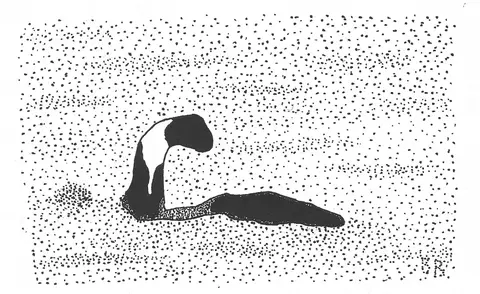
A pear-shaped, grayish, fibrous mass reported at roughly 18 to 21 feet long, about 7 feet wide and several tons in weight. Witnesses saw no clear head, eyes or bones; what looked like stumps of arms were later thought to be ridges in the decayed tissue.
Where and when it’s seen
A beach carcass on Anastasia Island, Florida’s Atlantic coast, in late 1896. Similar “globsters” have been reported around the world.
Notable sightings
- November 30, 1896Two boys find the carcass Anastasia Island, Florida
Boys cycling along the beach found the huge grayish mass partly buried in sand and told local people. Dr. DeWitt Webb examined it the following day.
- January 1897The carcass is lost and refound Crescent Beach, Florida
A storm washed the mass back to sea and it came ashore again about two miles south; Webb had it moved inland, after which its trail goes cold.
- April 1897Verrill changes his mind Yale University, Connecticut
Addison Verrill, who had named the mass Octopus giganteus, published a correction in The American Naturalist, concluding it was part of a sperm whale.
- 1995Electron microscope study Biological Bulletin
Sidney Pierce and colleagues reported that preserved samples were nearly pure collagen from the blubber of a large warm-blooded animal, supporting the whale explanation.
What could explain it?
- The most likely explanation, supported by Verrill’s retraction and later laboratory studies, is that the mass was the collagen-rich blubber layer of a dead sperm whale, which can persist as a shapeless lump after the rest of the carcass has rotted or been scavenged.
- The “arms” Webb saw were probably ridges in the decomposed tissue; Verrill later said he had been misled by those ridges and by a report of a 36-foot arm.
- Early octopus identifications relied on photographs and secondhand descriptions, a reminder of how easy it is to misread a decomposed carcass.
Legend, culture and tourism
The St. Augustine Monster is one of the best-known globsters in the world, and it remains a favorite of science writers and Florida history features. The story is also a textbook example of a scientist revising an announcement in public: the original “giant octopus” claim travelled much further than the correction.
Places to visit
A historic lighthouse and museum on the island where the carcass was found in 1896.
Where it’s reported
Sources
First published · Updated