Field file · Lake & sea monster · Local legend
Sandy Hook Sea Serpent
Also known as Shrewsbury River Sea Serpent, Navesink Sea Serpent, Jersey Shore Sea Serpent
A horned, bulldog-headed sea serpent reported around Sandy Hook, Red Bank and the Jersey Shore between 1879 and the 1890s and blamed on a giant squid.
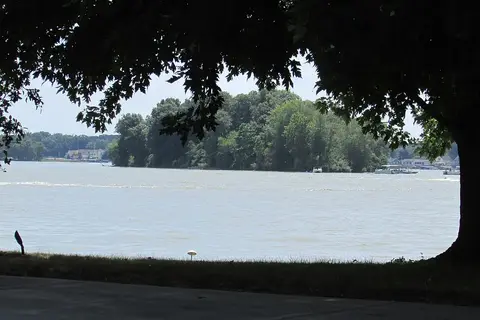
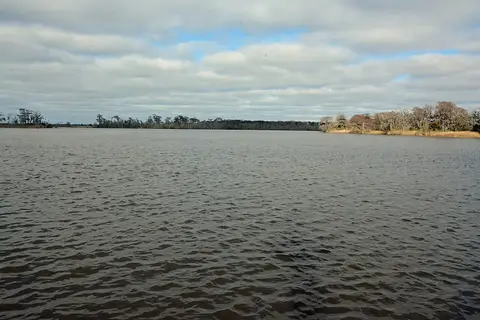
In the late nineteenth century the New Jersey shore had a sea serpent of its own. Newspapers and later storytellers place its home around Sandy Hook, the long sand spit that guards New York’s lower harbor, and in the tidal Shrewsbury and Navesink rivers that lead inland toward Red Bank, with later sightings farther down the Atlantic coast.
The earliest report in the usual retellings dates to November 1879, when members of the Sandy Hook Life Saving Service said they had seen a large serpentine creature just offshore. The surfmen’s descriptions were later examined by scientists, who are said to have concluded it was a giant squid. The most famous account is later, from the late 1880s: on a moonlit Sunday night about 10 p.m., the yacht Tillie S., owned by Marcus P. Sherman and returning to Red Bank from a picnic at Highlands Beach, met a huge animal in the river. Sherman and three friends, whom the Red Bank Register is quoted as calling sober and respectable merchants, described a creature about fifty feet long that undulated like a snake, with a small bulldog-like head, two short horns, eyes the size of silver dollars, cat-like whiskers, flat nostrils and a swordlike tail. It roared, the story goes, and headed for Hartshorne’s Cove. More than a dozen other boaters were said to have given nearly identical descriptions.
The sea serpent also earned national attention. Scientific American reported on the New Jersey sightings in December 1887 and, with drawings, suggested the animal was a giant squid. In September 1895 the New York Times reported that Philip N. Jackson, vice president of the Newark Electric Light and Power Company, had confirmed another man’s sighting of a fast-moving serpent about 100 feet long off Spring Lake, farther down the coast, and he said he had no doubt that it was a real sea serpent.
Today the New Jersey sea serpent survives chiefly through Weird NJ and other local-history writers. It rides the same wave as the era’s many Atlantic sea-serpent reports, from the Gloucester serpent of 1817 onward, a time when sightings in the press were treated as entertainment as well as news.
What witnesses describe
A long, serpentine animal said to be about 40 to 50 feet long (100 feet at Spring Lake), with a small bulldog-like head, two short rounded horns above huge round eyes, cat-like whiskers, flattened nostrils and a pointed, sword-like tail, moving with snake-like undulations and roaring.
Where and when it’s seen
Tidal rivers, bays and open water of Monmouth County: the Shrewsbury and Navesink rivers near Red Bank, Sandy Hook Bay, and the Atlantic off Spring Lake, mainly on summer evenings.
Notable sightings
- November 1879Life Saving Service crew at Sandy Hook Sandy Hook, New Jersey
Surfmen at the Sandy Hook station reported a large serpentine animal near shore. Scientists who took statements are said to have concluded that it was a giant squid.
- Late 1880sThe yacht Tillie S. Shrewsbury River near Red Bank, New Jersey
Four Red Bank men sailing home from a picnic described a roaring, horned, 50-foot serpent. The exact year is not stated in the usual retellings, which place it around 1887.
- December 27, 1887Scientific American weighs in New York
The magazine ran an article with drawings that attributed the sightings to a giant squid.
- September 30, 1895Sea serpent off Spring Lake Spring Lake, New Jersey
The New York Times reported that a Newark executive confirmed a New York man’s sighting of a 100-foot serpent moving at high speed half a mile offshore.
What could explain it?
- Giant squid: the explanation proposed in 1887 by Scientific American and attributed to the scientists who studied the 1879 reports.
- Oarfish or other large fish: the long, crested body of an oarfish and the horn-like features some witnesses described could be mistaken for a serpent, though the animals are usually found in deep water.
- Driftwood, schools of fish and porpoises: at dusk or by moonlight, a line of dolphins or a floating log can be read as a single long creature.
- Sensation-seeking press: nineteenth-century newspapers eagerly printed sea-serpent stories, and some tales spread by retelling, losing their source.
Legend, culture and tourism
The sea serpent is part of Monmouth County’s shore folklore, kept alive in Weird NJ and on local-history sites. It belongs to the wave of Atlantic sea-serpent reports that began with the Gloucester serpent of 1817 and kept the newspapers busy through the 1890s.
Places to visit
A National Park Service sand spit with beaches, a historic lighthouse and fort ruins, at the mouth of the waters where the serpent was reported.
Where it’s reported
Sources
First published · Updated