Field file · Lake & sea monster · Local legend
North Shore Monster
Also known as Great Salt Lake Monster, Old Briney
A bellowing, crocodile-bodied, horse-headed beast said to have chased saltworks men on the Great Salt Lake’s north shore in July 1877.
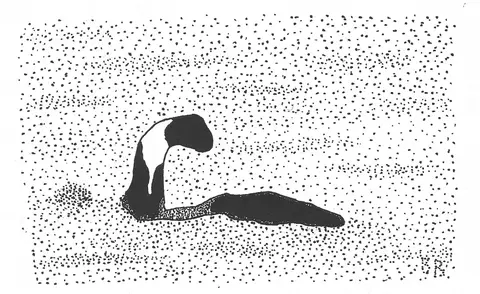
Utah is the land of nineteenth-century lake monsters – Bear Lake, Utah Lake and, according to the newspapers of the 1870s, the Great Salt Lake too. The best-known Great Salt Lake creature is the North Shore Monster, which comes from a single affidavit. In early July 1877, a man named J. H. McNeil, working with several others for the Barnes and Company saltworks near Monument Point on the lake’s northern shore, said that the crew heard a frightful bellow and looked up to see a creature with a body like a crocodile and a head like a horse’s. McNeil put its length at about 75 feet.
According to the account, the animal charged and the men ran for the mountains, where they hid overnight. The next morning they supposedly found boulders overturned and the ground torn up along the shore. McNeil signed a sworn statement, and the story ran in the Corinne Record and then in the Deseret News, whose editors advised readers to take it “with a few grains of salt.” The Corinne paper even suggested that it might be the same monster being reported at Utah Lake, a connection later writers consider unlikely.
Other Great Salt Lake tales accumulated around it. A state park ranger has told of unnamed hunters on Stansbury Island chased by a winged, crocodile-and-horse creature. A separate tall tale, dated to around 1873, claims that an Englishman released two Australian whales into the lake; researchers have noted that the lake’s salinity would rule it out. The nickname “Old Briney” comes later and was popularized by a 1976 spoof film about a giant brine shrimp, so it should be read as a joke that took on a life of its own.
Why a monster in a lake too salty for fish? Historian D. Robert Carter, who studied Utah’s lake-monster tradition, argued that the 1870s were simply a fashionable moment for such stories and that most reports reflect imagination and optical illusion rather than deliberate fraud. He also suggested that some settler tales may echo older accounts of water beings in Native American traditions (Ute tradition is often named), which are living beliefs that deserve to be understood on their own terms and not folded into monster stories.
What witnesses describe
A huge creature, said to be 75 feet long, with a crocodile-like body and a horse’s head, and a loud, frightening bellow. Later retellings add bat-like wings or an armored hide.
Where and when it’s seen
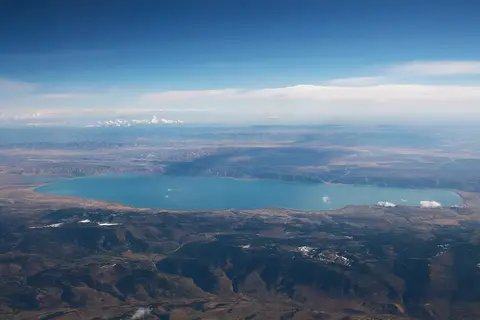
The remote north shore of the Great Salt Lake near Monument Point and, in later tales, Stansbury Island and Antelope Island. The lake is three to eight times as salty as the ocean, which limits its animal life to brine shrimp, brine flies and a few birds.
Notable sightings
- About 1873The Wickham whales Great Salt Lake, Utah
A famous but doubtful tale says an Englishman, James Wickham, brought two Australian whales to the lake to breed them for oil. University of Utah biologists point out that they could not have survived the salt.
- July 1877J. H. McNeil’s affidavit Monument Point, Great Salt Lake, Utah
McNeil and fellow workers at a saltworks reported a loud bellow and a crocodile-bodied, horse-headed monster; they fled to the hills and found overturned boulders in the morning. The Corinne Record and the Deseret News printed the claim.
- 1976Attack of the Giant Brine Shrimp Salt Lake City, Utah
A local filmmaker made a spoof monster movie about a giant brine shrimp. Lake storytellers later turned the film’s creature into “Old Briney.”
What could explain it?
- Some skeptics suggest a stray bison or other large animal seen near the shore, though the 75-foot length does not fit.
- Large carp in the fresher waters of nearby bays, mirages caused by the lake’s layered heat and salt, and floating debris could all account for reported sightings.
- The claim came from a single group of workers at a remote worksite and was printed in newspapers that competed with each other in the 1870s; the Deseret News itself flagged it as dubious.
- As Carter noted, the 1870s were a fashionable decade for lake-monster stories across Utah, and by the 1880s they had fallen out of favor.
Legend, culture and tourism
The North Shore Monster is the Great Salt Lake’s best-known legend, retold by Utah newspapers and by a state park ranger interviewed by FOX 13 around Halloween 2023. It sits alongside the Bear Lake Monster and the Utah Lake Monster in the state’s tradition of pioneer-era serpent tales.
Places to visit
The largest island in the Great Salt Lake offers beaches, bison and trails, with views across the water where the monster was said to roam.
Where it’s reported
Sources
First published · Updated